How Much Does an OTA Booking Cost — and Who Really Pays
There is a math that many hoteliers rarely do out loud, but feel every month when they see the bank statement.
A guest finds your hotel on an OTA platform. They book a room at 400 lei per night, for three nights. Booking value: 1,200 lei. Of that, between 180 and 240 lei — sometimes more — goes back to the platform as commission.
You open the bank statement at the end of the month. You look at the commission column. You add it up.
The sum is not catastrophic. But it's not small either. And it repeats every month, regardless of how hard you worked, regardless of how good the stay was, regardless of whether the guest was already your loyal customer who searched for you directly — and ended up on the platform anyway, because the booking button on your website either didn't exist or wasn't visible enough.
OTAs are a valuable channel. They bring visibility, they bring new guests, they work. The problem is not that they exist — the problem is when they become the only channel, when every booking goes through them, including those you could have won directly.
Sometimes it's worth it. Often, not as much as it seems at first glance.
Online Distribution — a Tool, Not a Strategy
OTA platforms have changed the hotel industry fundamentally and irreversibly. They brought global visibility to hotels that otherwise would not have existed on the map of international travelers. Nobody disputes that.
The problem is not that these platforms exist. The problem arises when they become the only booking channel — when the hotel becomes dependent on their traffic and pays commission for every guest, including those who would have found and booked directly.
Industry studies show that between 25% and 40% of guests who book through OTAs had previously searched for the hotel on Google or visited its website directly. They ended up on the platform out of inertia, out of habit, or because the booking button on the hotel's website was hard to find, complicated to use, or simply didn't exist.
This is the most expensive booking possible — a customer who already knew you and still paid commission on the way to you.
Your Website — a Catalog or a Sales Channel?
Most hotel websites function as digital brochures. They present the rooms, describe the amenities, show beautiful photos. And at the end, the booking button sends the visitor to an OTA platform.
It's a paradox that few hoteliers notice explicitly: you spend money on a website, invest in professional photography, pay for SEO and Google ads — to drive traffic to a page that ultimately sends the potential guest to an intermediary who charges you commission.
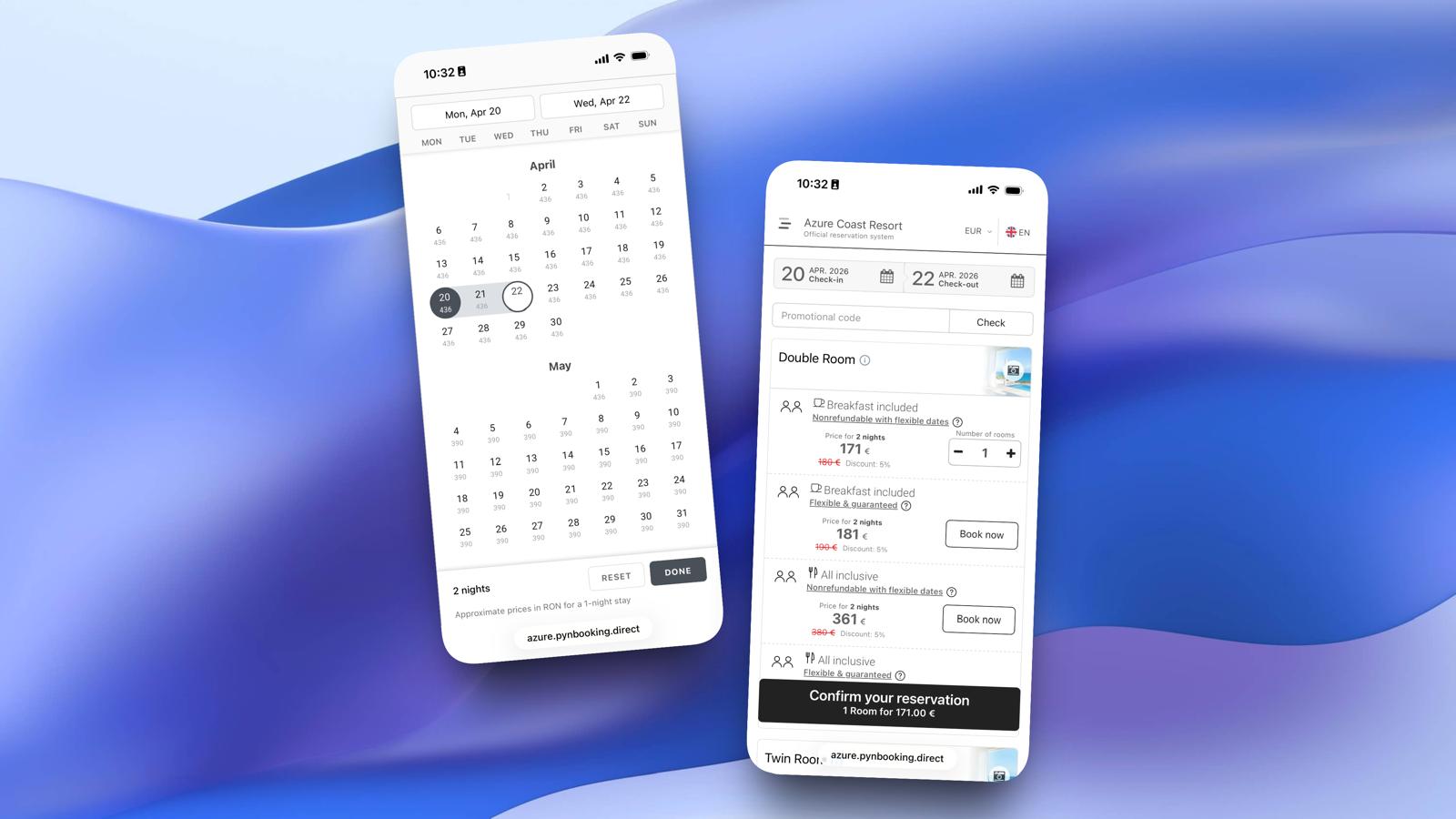
A booking engine changes this equation fundamentally. You're no longer a catalog — you become a sales channel.
The visitor arrives on your website, sees what you have to offer, and books directly, without going anywhere else. They pay online, receive the confirmation by email, everything is automatically recorded in the management system. No commission, no intermediary, no delay.
What a Well-Integrated Booking Engine Can Do
Beyond the simple booking function, a modern direct booking system brings several capabilities that change how the hotel interacts with guests even before arrival.
Packages and special offers. You can create personalized offers — city break, romantic weekend, family package — with configurable availability, minimum number of nights, and validity period. The guest sees them directly on your website, not on a platform where you compete with dozens of other hotels on the same screen.
Extra services at booking. Airport transfer, breakfast included, floral arrangement in the room, reserved parking — the guest can add these at the time of booking, before arriving at the hotel. You increase the average booking value without any additional effort from your team.
Vouchers and discount codes. You reward returning direct customers, offer corporate discounts or seasonal promotions, all applied automatically at checkout. Without depending on the promotion mechanisms of external platforms, which usually require participation in additional discounts to increase your visibility.
Integrated online payments. The guest completes the booking with Apple Pay, Google Pay, Visa or Mastercard. The payment is automatically recorded in the management system, and the invoice is sent by email without any manual intervention.
The Math of Direct Bookings
Let's do a simple calculation, without exaggerating anything.
A hotel with 30 rooms, with an average occupancy rate of 60%, makes approximately 540 bookings per year. If 40% of them come through OTAs, with an average commission of 18%, we're talking about roughly 216 bookings on which you pay commission.
At an average value of 800 lei per booking, total commissions reach somewhere around 31,000 lei per year — paid to platforms for bookings that many of those guests would have made directly if they had a simple and fast button on your website.
It's not a sum that ruins a hotel. But it's a sum that pays salaries, renovations, equipment — or stays in someone else's pocket.
Direct Booking — Better for Both Sides
There is a dimension of direct bookings that we often ignore: they are not just better for the hotelier, but also for the guest.
When you book directly, you communicate directly with the hotel. If you have a special request, you mention it at the source. If you want to modify the reservation or ask something specific, you send an email or call the hotel — not an outsourced call center of an international platform.
The hotel knows you're coming, knows what you prefer, can prepare the room according to your requirements. The relationship begins before check-in, not in the reception lobby.
And for the hotelier, a direct booking means a customer you know, to whom you can send a pre-arrival email with useful information, upsell offers, and an invitation to digital check-in. The relationship is built from the first click, not from the first step into the hotel.
Why Having a Website Is Not Enough
A website without a booking engine is like a store with a window display and no one at the cash register. People look, appreciate, and go buy from the neighbor.
But a poorly implemented booking engine is not much better. If the booking process has too many steps, if it doesn't work well on mobile, if it doesn't accept modern payment methods, or if it doesn't display real-time availability — the guest abandons and ends up on the OTA anyway.
A good booking engine is invisible. The guest arrives on your website, quickly finds what they're looking for, books in a few minutes, and receives instant confirmation. They don't feel like they used a technical system — they feel like they easily booked at a hotel that knows what it's doing.
OTAs Remain Useful — but in Their Proper Role
An article about direct bookings is not an attack on OTA platforms. They remain a valuable channel for visibility, especially for tourists who don't know you and discover your hotel for the first time.
The winning strategy is not to leave OTAs. It's to build a direct channel good enough that guests who discovered you there book directly next time.
That means a website that convinces, a booking engine that works flawlessly, and service that makes the guest want to return — this time directly.
Every direct booking is a relationship you build with a real guest. Every OTA booking is a transaction that passes through an intermediary who knows more about your guest's behavior than you do.
The best time to start changing this is now.
Pynbooking Booking Engine integrates natively with the PMS and enables direct bookings from the hotel's website, with no commissions. It includes management of special offers, extra services, vouchers, discount codes, and online payments with Apple Pay, Google Pay, and card.
