The Digital Restaurant — What You Gain When the Order Pad Disappears
There is a moment in any busy restaurant that you recognise immediately.
The waiter runs between tables, takes the order in a notepad, goes back to the kitchen to relay it verbally, the chef tries to decipher the handwriting, prepares what they understood, the waiter returns to check, discovers a mistake, goes back to the table to ask again. Meanwhile, the customer at table 7 has had their hand raised for five minutes.
This sequence is not an exception. It is the norm in thousands of restaurants — and it costs daily in lost time, mistakes, frustrated customers and sales that never happen.
Digitising the restaurant is not a trend or a luxury. It is the answer to a real operational problem that occurs every shift.
The Digital Order — What Changes in Practice
When the waiter takes the order on a tablet or phone instead of a notepad, it is not just a change of instrument. It is a change of flow.
The digitally recorded order arrives instantly on the kitchen monitor — clearly, completely, with all special notes, with the time it was placed. The chef confirms they have received it. When the dishes are ready, the waiter receives an alert on their phone that they can pick up the order.
Each step is traced. There is no information lost in transit between the dining room and the kitchen. There are no interpretations of illegible handwriting. There are no situations where the waiter forgot to relay a modification.
The immediate result: the table is served faster, with fewer errors — and the waiter spends more time in the dining room, with customers, instead of making trips to the kitchen.
What the Customer Gains When They Can Order Themselves
There is a change in behaviour in restaurants that you observe more and more often: customers want to order without waiting for the waiter.
Not from a lack of appreciation for service — but from the frustration of having their hand raised for three minutes in a busy restaurant, or from the comfort of studying the menu without the pressure of someone waiting for their answer.
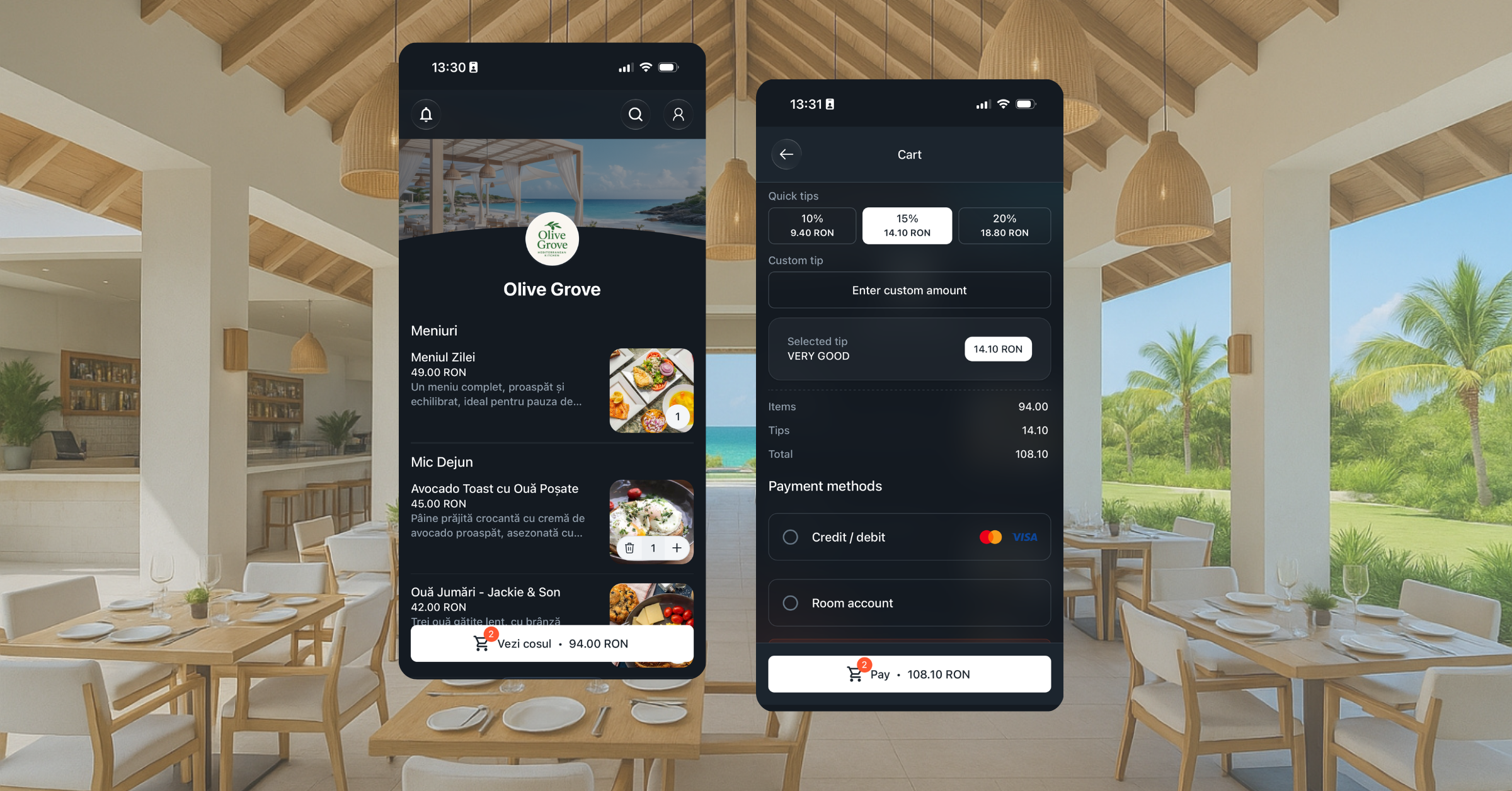
A QR digital menu solves exactly this. The customer scans the code on the table, sees the menu with photos and descriptions, chooses, orders. The waiter receives the order on the tablet without having passed by the table.
For the restaurant, the effect is twofold. The table is served faster, and turnover increases without adding staff. A waiter can manage more tables simultaneously because they no longer spend time taking orders verbally and relaying them to the kitchen.
The digital menu also has an important practical advantage: prices and availability update in real time. The customer does not order a dish that is no longer available. There are no awkward situations where the waiter has to come back to announce that the restaurant has run out of that dish.
Stock — From Estimation to Certainty
One of the recurring problems in restaurant management is the discrepancy between what should be in stock and what actually is.
The manual system operates on estimates and periodic inventories. Between two inventories, you do not know exactly what has been consumed, what has expired, what is missing. You discover you have run out of an ingredient at 8pm on a Friday evening, when you can no longer order.
When each completed order automatically deducts ingredients from stock — according to recipes defined in the system — the inventory reflects reality at any moment. Not an estimate, not an average. Reality.
The system alerts when an ingredient reaches a critical level — before it creates a problem, not after. The manager sees stock levels from each store at any moment, from any device, without being physically present in the restaurant.
Reports That Replace Intuition With Data
Which dishes sell best? At what times is the restaurant at full capacity? Which waiter has the highest sales per table? Which products take up menu space but generate no profit?
Without a digital system, the answers to these questions are intuitions — sometimes correct, sometimes not. With a digital POS, they are real data, available immediately, filtered by any period.
Decisions based on data look different from those based on intuition. Eliminating a dish that seems popular but has a high cost and small margin. Identifying real peak hours and allocating the team accordingly. Understanding which menu categories bring the most profit and building promotional offers around them.
The Restaurant Integrated With the Hotel — A Separate Chapter
For accommodation units with their own restaurant, the integration between POS and PMS brings an additional benefit beyond all of the above.
The restaurant order goes directly to the guest room folio — without manual transcription, without phone calls between reception and the restaurant, without situations where dinner charges are missing at checkout.
The guest sees in the guest app everything they have consumed during their stay — room, restaurant, spa, minibar — in a single account, updated in real time. At checkout, there are no surprises and no disputes.
Delivery and Online Orders — Same System
Restaurants that also offer home delivery or online orders for collection can manage this flow from the same system — without a separate application, without a parallel system to manage.
The online order goes directly into the POS, appears on the kitchen monitor like any other order, is prepared and marked as ready. The inventory updates. The invoice is generated automatically.
A single system for all channels — dining room, room service, online orders — means a single place from which the manager has the complete picture of the operation.
Digitalisation That Does Not Require New Equipment
A practical detail that matters to many restaurateurs: a modern cloud POS works on any existing device — phones, tablets, laptops, Windows, iOS or Android. It does not require dedicated equipment, does not require cables and section printers, does not require installation on each individual device.
Waiters log in simply, like any application. Chefs see orders on any available screen in the kitchen. The manager accesses reports from their phone, from anywhere.
Going digital does not mean a major investment in infrastructure. It means, in most cases, making better use of what you already have.
Pynbooking POS Restaurant works on any device, without installation, natively integrated with the PMS for the automatic transfer of charges to guest rooms. Includes QR digital menu, Kitchen Display System, real-time stock management, complete reports and automatic export to accounting systems.
